


Javier Lopez
Jlopezmedinaceli@lc.edu
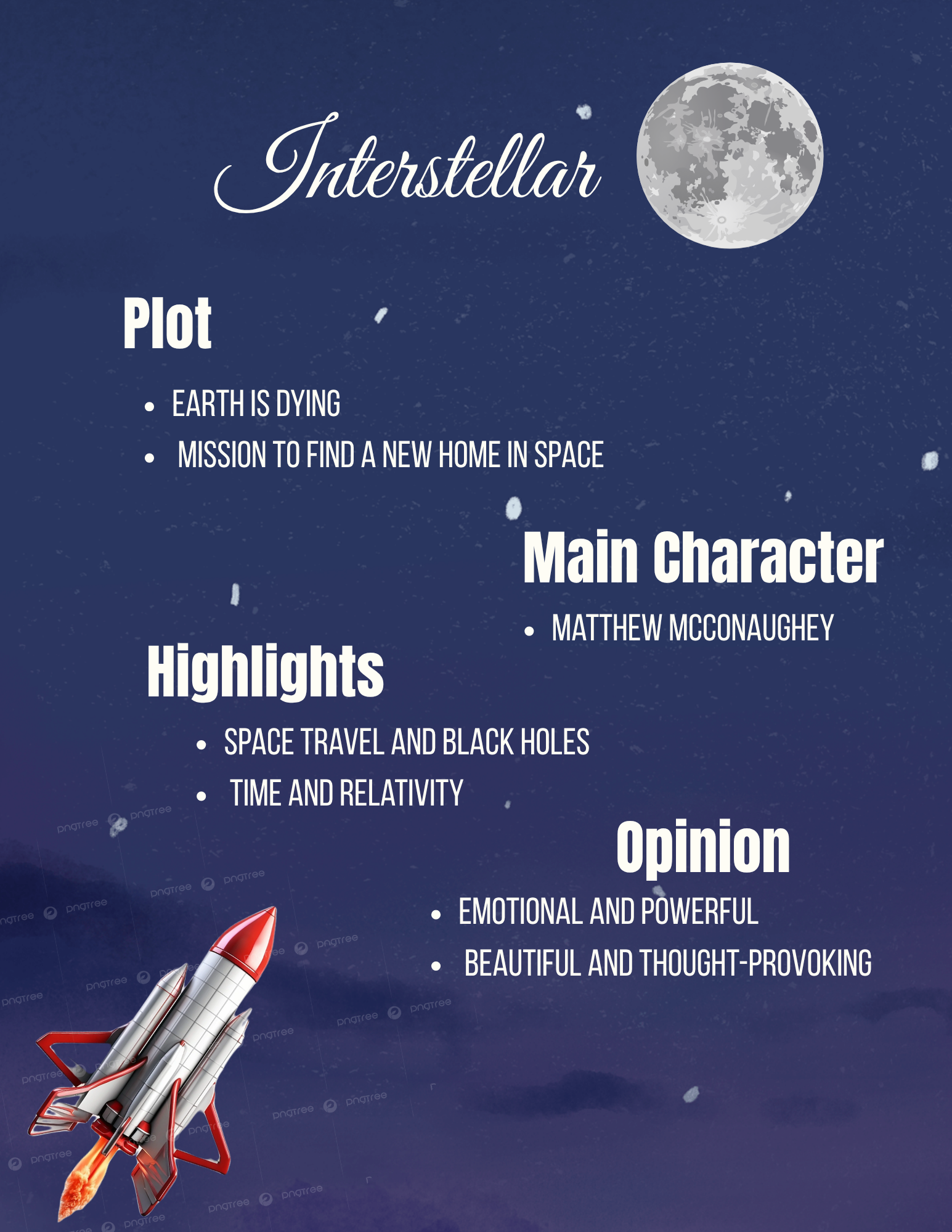
Godfrey – Directed by Christopher Nolan and released in 2014, Interstellar is one of the most ambitious and emotional science fiction films of modern cinema. Starring Matthew McConaughey, it blends space exploration, scientific theory, and deep human emotion.
The story is set in a future where Earth is on the brink of collapse due to resource shortages and massive dust storms. Cooper, a former NASA pilot turned farmer, is given the mission to travel through a wormhole in search of a new home for humanity. Alongside a team of scientists, he embarks on a journey that challenges not only the limits of space, but also of time itself.
One of the film’s most impressive aspects is its scientific foundation. Christopher Nolan worked closely with physicist Kip Thorne to accurately portray concepts such as black holes, relativity, and time dilation. This is especially evident in iconic scenes where just a few hours on a planet equal years back on Earth.
Visually, Interstellar is stunning. From the vastness of space to the depiction of the black hole Gargantua, the film delivers unforgettable imagery, enhanced by a powerful score composed by Hans Zimmer, which elevates every emotional moment.
However, beyond the science, the heart of the film lies in its human story. The relationship between Cooper and his daughter Murph is the emotional core. Through distance, time, and difficult choices, Interstellar explores themes of sacrifice, hope, and love as a force that transcends even space and time.
The ending, open to interpretation, has sparked countless theories and discussions, adding even more depth to the experience.
In summary, Interstellar is not just a science fiction film, but an emotional and philosophical journey that invites us to reflect on our place in the universe—further solidifying Christopher Nolan as one of the great directors of our time.